If your Minnesota property tax seems higher than expected, the issue is often related to an incorrect assessed market value or property classification, not the tax rate itself. Many homeowners and investors overpay simply because they do not review their valuation notice carefully. This guide explains the complete process, deadlines, and strategies to reduce your tax burden legally in 2026. In fact you can now easily download the appeal guide in PDF from for every county in Minnesota state.
Minnesota Property Tax Appeal – Key Facts (2026)
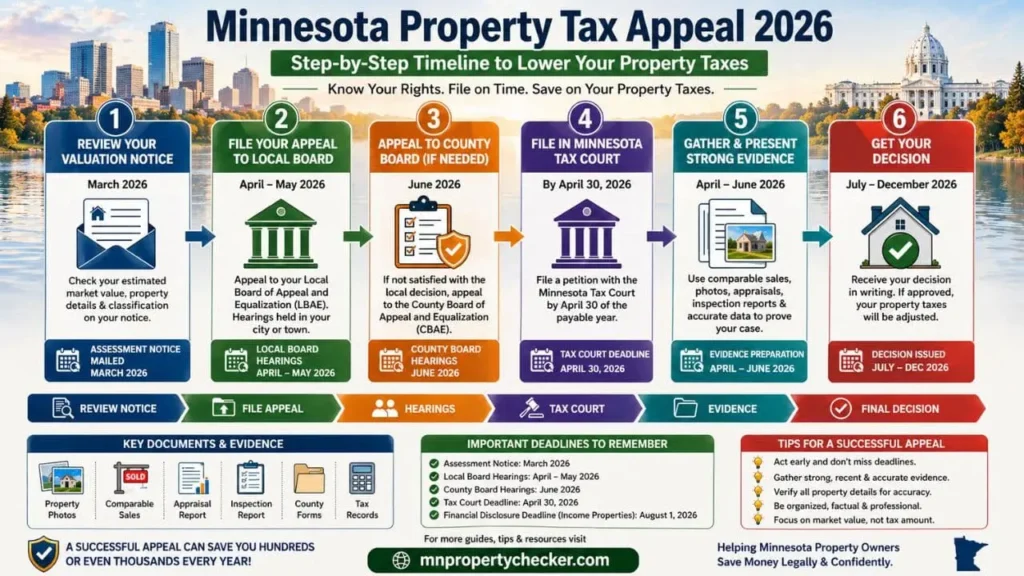
In Minnesota, property owners do not have the right to appeal the total tax bill directly. Instead, they can challenge the estimated market value or classification assigned by the county assessor. The valuation notice is usually mailed in March, and it starts the appeal window. Local hearings occur between April and May, followed by county-level hearings in June, while the final Tax Court deadline is April 30 of the payable year.
| Stage | Timeline | Details |
|---|---|---|
| Assessment Notice | March 2026 | Review property value |
| Local Board | April – May | First appeal level |
| County Board | June 2026 | Second review |
| Tax Court Deadline | April 30, 2026 | Final appeal option |
| Disclosure Deadline | August 1, 2026 | For income properties |
What Is a Minnesota Property Tax Appeal?
A Minnesota property tax appeal is a formal process where a property owner disputes the assessor’s valuation or classification. The goal is to prove that the assigned value does not reflect the true market value. Since property taxes are calculated based on assessed value, even a small reduction can lead to meaningful savings. This process ensures fairness and accuracy in the local taxation system.
When Should You Appeal Your Property Value?
Property owners should consider filing an appeal when they notice inconsistencies between their property’s assessed value and actual market conditions. If your valuation seems unrealistic compared to similar properties, or if your property details are incorrect, it may be time to act. Identifying valid reasons early increases your chances of a successful outcome.
Overvalued Property Compared to Market
If your property is assessed higher than recent sales of similar homes in your area, it is a strong signal of overvaluation. Real estate markets fluctuate, and assessors may not always reflect current trends. Reviewing comparable sales from the past one to two years can help you determine whether your valuation is accurate or inflated.
Incorrect Property Information
Assessment errors are more common than many people think. Incorrect data such as wrong square footage, outdated renovations, or extra features listed in records can significantly increase your valuation. Carefully reviewing your property record card and correcting these errors can lead to a lower assessed value and reduced tax liability.
Property Condition Issues
If your property has structural issues, damage, or requires major repairs, these factors should be reflected in its market value. However, assessors may not always account for internal or hidden problems. Providing photos, inspection reports, and repair estimates helps demonstrate why your property should be valued lower than similar well-maintained properties.
Wrong Property Classification
Property classification affects how your property is taxed. For example, a home incorrectly classified as non-homestead may face a higher tax rate. Similarly, commercial or rental properties must be categorized correctly. If your property use has changed or was recorded incorrectly, appealing the classification can significantly reduce your tax burden.
Step-by-Step: How to Appeal Property Tax in Minnesota
The appeal process becomes easier when broken into clear steps. Following the correct order ensures that you do not miss deadlines or submit incomplete information. Each step is important and contributes to building a strong and successful case.
Review Your Valuation Notice
When you receive your notice in March, carefully check the estimated market value, classification, and property details. Compare this information with your actual property condition and recent sales in your area. Identifying discrepancies at this stage helps you prepare a strong foundation for your appeal.
Contact Your County Assessor
Before filing a formal appeal, it is recommended to contact your county assessor. Many disputes are resolved through a simple discussion, saving time and effort. You can request a property review or inspection if your property has not been recently evaluated, which may correct the issue without further action.
Gather Strong Evidence
A successful appeal depends on solid, factual evidence rather than personal opinions. You should collect comparable sales data, property photos, repair estimates, and appraisal reports. The more accurate and recent your data is, the stronger your case becomes when presented before the board or court.
Appeal to Local Board (April–May)
The Local Board of Appeal and Equalization is usually your first formal step. These hearings are held between April and May and are often managed by local government officials. You can present your case in person, submit documents, or even send a written appeal explaining why your valuation should be adjusted.
Appeal to County Board (June)
If you are not satisfied with the local board’s decision, you can escalate your appeal to the County Board of Appeal and Equalization. These hearings take place in June. The county board reviews your case again and may provide a different outcome based on the evidence you present.
File in Minnesota Tax Court (Deadline: April 30)
The Minnesota Tax Court is the final and most formal option for appealing your property valuation. You must file your petition by April 30 of the payable year. This process is more legal and may take longer, but it offers a final opportunity to challenge your assessment and potentially receive a refund.
Minnesota Property Tax Appeal Deadlines (2026)
Understanding deadlines is critical because missing even one can eliminate your right to appeal for the entire year. The process begins in March with valuation notices, followed by local and county hearings in spring and early summer. The Tax Court deadline on April 30 is the most important date, especially for formal appeals.
What Evidence Wins an Appeal?
Winning an appeal depends on presenting clear, factual, and relevant evidence that supports your claim. Authorities rely on data-driven decisions, so your documentation must directly show that your property is overvalued or misclassified compared to similar properties.
Comparable Sales Data
Comparable sales are one of the strongest forms of evidence in property tax appeals. These include recently sold properties with similar size, location, and features. Using accurate comparables helps demonstrate that your assessed value is higher than what buyers are actually paying in the market.
Property Condition Proof
Photos and repair estimates are essential when your property condition is below average. Visual evidence clearly shows issues that reduce value, such as structural damage or outdated interiors. This type of proof strengthens your case by providing real, measurable reasons for a lower valuation.
Accurate Property Data
Ensuring that all property details are correct is critical. Errors in square footage, number of rooms, or property features can significantly impact valuation. Correcting these inaccuracies can sometimes resolve the issue without needing a full appeal process.
Professional Reports
Professional appraisals and inspection reports carry strong weight in appeals. These documents provide an expert opinion on your property’s value and condition. Including them in your case adds credibility and increases your chances of success.
Informal vs Formal Appeal Options
Minnesota offers both informal and formal appeal paths, allowing property owners to choose based on their situation. Informal appeals are quicker and less complex, while formal Tax Court cases provide a more detailed legal review.
Informal Appeals
Informal appeals include discussions with assessors and hearings at local or county boards. These are faster, usually resolved within 30 to 90 days, and do not require legal representation. They are ideal for simple valuation disputes and first-time appeals.
Tax Court Appeals
Tax Court appeals are more formal and follow legal procedures. They may take one to two years to resolve but are suitable for complex or high-value cases. This option is often used when informal appeals do not result in a satisfactory outcome.
Common Mistakes to Avoid
Many property tax appeals fail due to avoidable mistakes. Understanding these errors helps you prepare better and increases your chances of success. Proper planning and accurate documentation are key factors in winning your case.
Missing Deadlines
Deadlines in Minnesota are strict and non-negotiable. Missing them means losing your right to appeal for that year. It is important to track all important dates and act early to avoid last-minute issues.
Lack of Evidence
Submitting an appeal without proper documentation weakens your case. Authorities require factual proof, not opinions. Strong evidence is essential to justify any requested changes in valuation or classification.
Using Weak Comparable
Choosing properties that are not truly similar can harm your appeal. Comparables must match your property in size, location, and condition to be effective and credible.
Focusing on Tax Amount
Many applicants make the mistake of arguing about high taxes instead of property value. The appeal process focuses only on valuation and classification, not the tax amount itself.
Conclusion
A Minnesota property tax appeal is a powerful tool that ensures your property is taxed fairly based on accurate data. By reviewing your valuation notice, gathering strong evidence, and following the correct process, you can significantly reduce your tax burden. Acting early and staying informed is the key to success in 2026.
How do I get a Minnesota property tax appeal guide PDF?
You can download official guides from the Minnesota Department of Revenue website, which provides fact sheets and appeal instructions. Many county assessor offices also offer downloadable PDFs with step-by-step appeal procedures, forms, and deadlines specific to your location.
Can I appeal my property tax through the MN Department of Revenue?
No, the Minnesota Department of Revenue does not handle individual property tax appeals directly. Appeals are managed at the local assessor level, County Board of Appeal and Equalization, or Minnesota Tax Court, depending on your case and stage in the process.
Should I appeal my property tax assessment in Minnesota?
You should consider an appeal if your property’s estimated market value is higher than similar recent sales, or if there are errors in property details or classification. A well-supported appeal can reduce your assessed value and lower your annual property tax burden.
What is estimated market value in Minnesota property tax?
Estimated market value is the assessor’s opinion of what your property would sell for on the open market. It is determined using sales data, property condition, and location factors. This value is the key figure used to calculate your property tax.
How do I file a property tax appeal in Ramsey County, Minnesota?
In Ramsey County, you start by reviewing your valuation notice and contacting the assessor. If needed, you can appeal to the Local Board (April–May), then the County Board (June), or file a petition with the Minnesota Tax Court by April 30 for a formal review.